 Back to Blog
 LifeCare Editorial Team
 December 30, 2025
Advanced Practice Provider Billing (APP) + RCM Guide for 2025 (LifeCareBilling)
Advanced Practice Providers are no longer “just support.” In real private-practice workflows, APPs drive access, continuity, and growth. Nurse Practitioners and Physician Assistants carry panels, manage complex follow-ups, run telehealth schedules, and keep patient care moving when demand is high and physician calendars are packed.
But there’s a truth most APPs only learn after a few painful months: clinical ability doesn’t automatically translate to predictable revenue. Your practice can be busy and still feel financially unstable if your billing workflow is unclear, your enrollment is delayed, your documentation doesn’t match payer expectations, or your team is constantly stuck in denial management and rework.
That’s why LifeCareBilling is built specifically for APPs who want to practice confidently and grow—whether you’re joining a group, leading care in a collaborative model, or becoming an Independent Provider (IP). We provide end-to-end support for advanced practice provider billing, RCM for private practice, telehealth workflows, credentialing and enrollment, documentation structure, compliance tracking, and reporting visibility—so you can build a practice that runs like a system instead of a guessing game.
This guide is written like a real blog for real APPs. It explains how APP billing actually works in today’s environment, why claims get denied, how to choose the right billing method, and how LifeCareBilling supports you in every step—not only at the end.
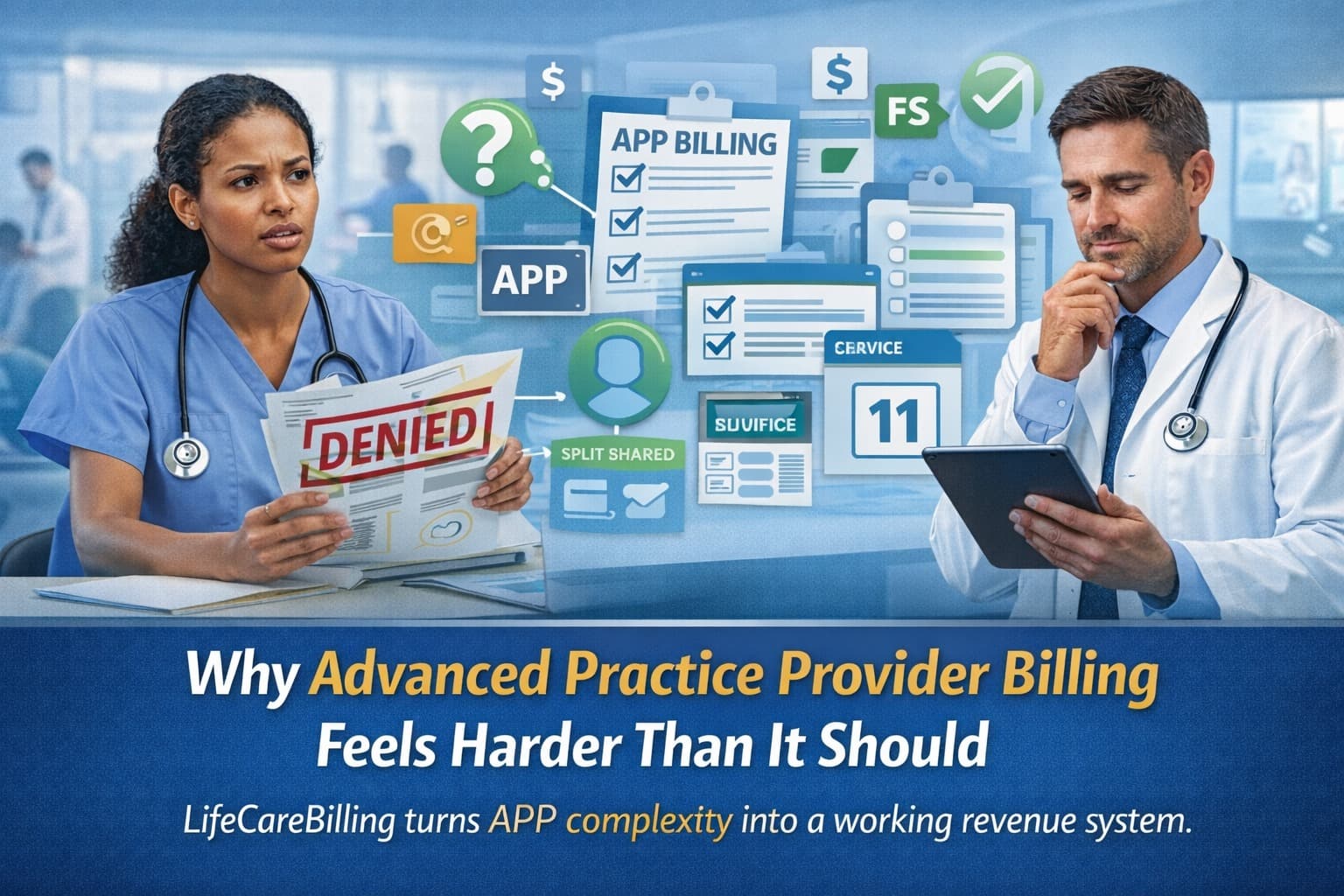
Why APP billing feels harder than it should
Most billing problems don’t start at the claim. They start earlier, quietly, during intake and workflow decisions that happen in the background of a busy clinic day.
A single incorrect digit in insurance details can trigger delays. A missed eligibility check can turn into a denial that eats staff hours. A provider might be fully capable clinically, but not fully linked in payer systems yet—so claims reject even when the visit was perfect. Documentation might reflect excellent care, but not clearly support E/M coding guidelines or payer requirements for who should bill the service. And when your practice relies on multiple clinicians, the “who bills this visit” question becomes a daily bottleneck.
APP billing becomes complicated because the same visit can be billed in different ways depending on the setting, the payer policy for APP reimbursement, and the documentation details. Your reimbursement and compliance risk can change based on whether you bill under your own NPI (direct billing NP and NPI billing), whether a visit meets incident-to billing requirements, or whether an institutional visit qualifies for split/shared billing with modifier FS and a supported substantive portion (MDM or time).
LifeCareBilling helps by turning this complexity into a repeatable operating system. We don’t just work claims. We build workflows that prevent avoidable denials, reduce rework, and protect revenue while you scale.
What is Advanced Practice Provider Billing (APP billing)?
Advanced practice provider billing is the process of submitting claims for NP/PA services in a way that matches the payer’s rules, the care setting, and the documentation requirements for that specific encounter.
In everyday practice, your billing decision usually comes down to three simple questions.
Who is billing the visit—physician billing or APP NPI billing?
Where did it happen—office (often place of service 11) or a facility setting where rules can change and split/shared becomes relevant?
Does the documentation support the method you’re using—especially when the payer expects proof of who performed the substantive portion, or requires a claim identifier like modifier FS?
LifeCareBilling supports these decisions with workflows and tools specifically tailored to advanced practice. That means documentation templates built for APP notes, telehealth-ready workflows, credentialing and enrollment support, and reporting that makes your billing performance visible—not hidden.
Becoming an Independent Provider is much easier than you think—if your revenue engine is built correctly
APPs don’t struggle because they lack clinical talent. They struggle because independence requires operational confidence.
You may have asked yourself questions like: Will I get paid correctly if I bill under my NPI? How do I avoid incident-to billing mistakes? What is split/shared billing and who can bill it? What counts as the substantive portion—MDM or time? How do I credential an advanced practice provider across states for telehealth? Why are my APP claims getting denied even though patients are being seen every day?
LifeCareBilling exists for this exact shift: taking APPs from working inside someone else’s system to running a compliant, scalable system of their own. We support advanced practice providers with medical billing, revenue cycle management, credentialing management, APP-specific templates, quality metrics tracking, collaborative care tools, and prescriptive authority tracking—so your practice operations and compliance stay aligned while you grow.
Direct billing under your own NPI: the clean foundation for independence
Direct billing NP or PA direct billing is often the easiest billing path to standardize because it’s simple operationally: the provider who performs the visit bills the visit under their own NPI.
For many APPs building independence, direct billing is the first stable foundation. It reduces confusion, improves audit defensibility, and works well for APP-led visits and telehealth workflows where supervision-based models are harder to maintain consistently.
Where direct billing fails is rarely clinical. It fails when credentialing and enrollment isn’t complete, when group linkage is misconfigured, when payer enrollment is delayed, or when documentation doesn’t support the E/M coding guidelines expected by the payer.
This is exactly where LifeCareBilling supports you. We help with provider enrollment workflows, credentialing management, and operational setup so direct billing doesn’t turn into rejected claims. We also support APP-specific documentation templates so your notes read cleanly for patient care and still support billing requirements without extra back-and-forth.
Incident-to billing: valuable when it’s structured, risky when it’s assumed
Incident-to billing is often discussed in private practices because it can be beneficial when used correctly and when payer rules allow it. But incident-to is not a “quick choice” you make after the visit. It is a workflow you must be able to support consistently.
The practices that struggle the most with denial management often have one thing in common: incident-to is applied loosely. A visit gets billed one way because it “usually works,” not because the practice can prove it meets the requirements every single time.
If you’re wondering how to avoid incident-to billing mistakes, start here: never treat incident-to as your default. Treat it as a structured pathway. Your plan of care must be clear. The visit must align to that plan. Supervision expectations must be met. Documentation must match the billing method. And your staff must know when a visit does not qualify—without hesitation.
LifeCareBilling helps by building clarity into your workflow. We support documentation structure, billing logic, and operational processes so your team isn’t guessing at submission time. That reduces repeated denials and keeps your compliance position stronger as volume increases.
Split/shared billing: where many APP-heavy workflows lose money quietly
Split/shared billing is one of the most misunderstood areas of advanced practice provider billing, especially when APPs and physicians collaborate across the same encounter.
In institutional or facility settings, split/shared E/M billing depends on who performed the substantive portion. That’s why people ask, “what counts as the substantive portion—MDM or time?” Because the answer drives who should bill the visit. Medicare also uses modifier FS to identify split/shared visits in applicable cases, and missing it can contribute to claim issues.
In real-world operations, split/shared breaks down when documentation is unclear. Notes become blended. Time is tracked loosely. MDM contribution isn’t obvious. A claim goes out without the right identification. Then the practice spends days doing rework, appeals, and A/R follow-up.
LifeCareBilling supports split/shared workflows by helping practices standardize note structure and documentation habits so the billing path stays defensible. We also support collaborative care tools so consultation and coordination don’t happen in scattered messages or disconnected systems. When your workflow is connected, your documentation becomes easier, your claims become cleaner, and your revenue cycle becomes more predictable.
Documentation that supports reimbursement without slowing you down
APPs don’t need “more documentation.” They need smarter documentation that matches how APPs actually practice, especially in telehealth and fast-paced private practice.
When your documentation is aligned with E/M coding guidelines and payer expectations, it prevents downcoding, reduces rejections, and lowers denial rates. When it isn’t, every visit creates a billing question later. That’s when a busy clinic becomes a busy billing office.
LifeCareBilling supports documentation efficiency through APP-specific templates that are designed for NPs, PAs, CNMs, and other advanced practice providers. These templates support SOAP notes, procedure documentation, and telehealth patient charts, so documentation stays consistent and billing-ready without rewriting everything after the visit.
We also support clinical decision support so evidence-based guidelines and protocols are accessible in the workflow. That improves consistency, supports clinical quality, and helps reduce coding/documentation mismatch that often triggers denials.
Credentialing and enrollment: the silent reason APP claims get denied
If you’ve ever thought, “why are my APP claims getting denied?” and the visit looked perfect, credentialing and enrollment is often the missing piece.
APP revenue can collapse quietly when payer enrollment is delayed, multi-state credentialing is incomplete, or the provider isn’t linked correctly to the billing group and payer system. This is especially painful for telehealth growth. You can see patients today, but reimbursement may lag or deny because administrative setup isn’t complete.
LifeCareBilling includes credentialing management designed for APP reality. We help track licenses, certifications, DEA registrations, continuing education needs, payer enrollment progress, and multi-state compliance. That means your growth isn’t blocked by “paperwork bottlenecks” that should have been handled before they hit your cash flow.
Telehealth + APP billing: where growth either scales smoothly or breaks fast
Telehealth is one of the biggest opportunities for APPs becoming Independent Providers. But telehealth revenue only scales when your workflow is built correctly from day one.
Telehealth claims can face denials when patient data is incomplete, coverage isn’t verified, documentation doesn’t match payer expectations, or your processes vary from state to state and payer to payer. Once volume grows, it becomes impossible to “fix it later” without creating major A/R aging and instability.
LifeCareBilling supports telehealth workflows by combining billing and RCM processes with documentation structure, compliance tracking, and reporting visibility. That way you don’t just run telehealth visits—you run a telehealth operation that gets paid predictably.
Denial management and A/R follow-up: how LifeCareBilling protects cash flow
Denials are not only a billing issue. They’re a workflow feedback signal. If you don’t track denial reasons, fix root causes, and follow up consistently, the same problems repeat every month and A/R grows until cash flow feels unpredictable.
LifeCareBilling supports denial management, A/R follow-up, and reporting dashboards so you can see what’s slowing payments and why. That includes performance analytics and KPI visibility that helps you run your practice like a business, not like a guessing game. When denials drop and follow-up becomes consistent, your revenue cycle stabilizes—even if your schedule is fuller than ever.
Advanced Practice Provider billing services in New York, Long Island, and beyond
If you’re searching for advanced practice provider billing services New York, nurse practitioner billing services New York, physician assistant billing services New York, outsourced APP billing Long Island, APP billing company near me, RCM for private practices New York, denial management services New York, or provider enrollment for NPs New York—this is exactly the workflow LifeCareBilling is built to support.
Whether you’re launching a new APP-owned practice, scaling telehealth, or operating inside a collaborative model, LifeCareBilling provides end-to-end support for billing, RCM, credentialing, documentation, compliance, and reporting—so you can grow without losing control.
LifeCareBilling: one-stop support for APPs becoming Independent Providers
LifeCareBilling provides a complete solution for advanced practice providers, supporting medical billing, revenue cycle management, telehealth workflows, credentialing and enrollment, APP-specific documentation templates, quality metrics tracking, prescriptive authority compliance support, and practice operations.
If you want a clean next step, start here.
Call (631) 966-1755 or click Get Billing Analysis to talk to an expert and see exactly what’s working, what’s leaking revenue, and how to build a smoother APP billing workflow that supports growth.
Frequently Asked Questions
What is APP billing?▼
APP billing is the process of submitting NP/PA claims under the correct provider and billing method based on payer rules, setting, and documentation requirements, including direct billing, incident-to, and split/shared billing.
Should I bill under my NPI or use incident-to billing?▼
If you want consistency and clear ownership, direct billing under your NPI is often the cleanest operational foundation. Incident-to can work in specific structured scenarios, but it requires strict workflow discipline to avoid repeated denials.
What is split/shared billing and who can bill it?▼
Split/shared is used when a physician and APP both contribute to an E/M visit in a facility setting, and billing depends on who performed the substantive portion. Claims may require modifier FS depending on payer rules and reporting expectations.
How do I reduce denials for APP visits?▼
Denial reduction usually starts earlier than the claim: cleaner intake, eligibility verification, correct enrollment, method-specific documentation, consistent A/R follow-up, and weekly denial tracking to fix root causes.
How does LifeCareBilling help advanced practice providers?▼
LifeCareBilling supports APPs with medical billing, RCM, telehealth workflows, credentialing management, APP-specific templates, compliance support, denial management, A/R follow-up, and reporting dashboards—so you can launch and grow as an Independent Provider with full operational support.