 Back to Blog
 LifeCare Editorial Team
 January 16, 2026
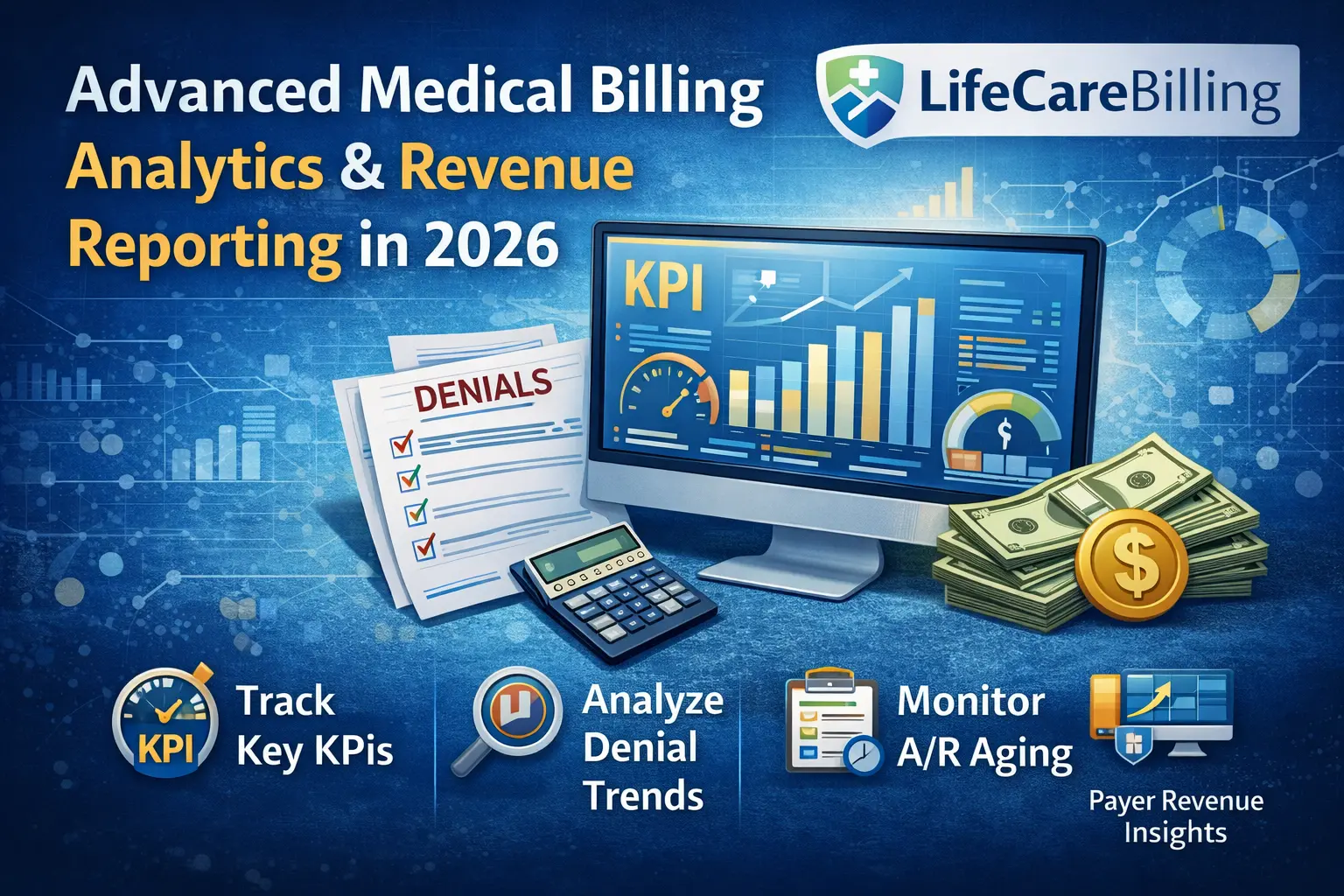
Advanced Analytics & Revenue Reporting in 2026: The Complete Guide
In 2026, most practices don’t struggle because they “aren’t billing.” They struggle because money moves through the revenue cycle with too many blind spots. Claims go out, denials come back, A/R grows, and leadership hears the same sentence every month: “We’re working on it.” The truth is, without the right analytics and revenue reporting, it’s hard to know what “it” even is.
Advanced analytics changes that. It turns your billing operation into something measurable. Not in a confusing, data-heavy way, but in a practical way that answers real business questions: Where is cash getting delayed? Which payers are causing friction? Which denial reasons keep repeating? Are we improving, or are we just staying busy?
At LifeCare Billing, we treat revenue reporting like a control panel. If you can see the right metrics clearly, you can make better decisions faster. And when decisions get faster, cash flow gets healthier.
Why revenue reporting is different in 2026
The big shift in 2026 is that reporting isn’t just “a monthly snapshot” anymore. Practices want a system they can rely on week after week. Payers change behavior quickly, documentation requirements evolve, patient responsibility continues to rise, and small operational delays can quietly turn into large cash problems. You can’t manage that with a single month-end report that arrives after the damage is already done.
Revenue reporting in 2026 is about early signals. It’s about noticing the denial trend before it becomes a denial wave. It’s about seeing charge lag creep up and fixing it before cash slows down. It’s about catching payer underpayments and preventing thousands in missed revenue from slipping by unnoticed.
So when we say “advanced analytics,” we don’t mean complicated. We mean earlier, clearer, and actionable.
What “advanced analytics” really means in medical billing
Basic reporting tells you what happened. Advanced analytics tells you why it happened and what to do next.
In a modern practice, advanced analytics usually includes three things working together:
First, a dashboard view that highlights the few KPIs that actually matter. If a dashboard shows 40 numbers, nobody uses it. If it shows the 8–12 metrics that explain cash flow, leadership checks it regularly.
Second, drill-down visibility. When something looks wrong, you should be able to trace it back to the source. Not just “denials are up,” but “denials are up mostly for one payer, mostly for one service type, mostly for one reason.” That’s where real improvements come from.
Third, a reporting rhythm. Reporting is useless if nobody looks at it at the right time. Analytics becomes powerful when it’s connected to a weekly operating routine where the team reviews, assigns fixes, and tracks whether the fixes worked.
That’s what makes analytics “advanced” in 2026: it drives action, not just awareness.
The dashboards that protect cash flow
A/R performance and aging (where money gets stuck)
A/R is one of the most honest mirrors of revenue cycle health. If A/R is growing, it usually means your cash is delayed somewhere, even if charge volume looks strong. A/R aging adds another layer of truth: it shows how long money has been sitting unpaid and where follow-up is failing.
This matters because time isn’t neutral in billing. The older a balance gets, the harder it often becomes to collect. A strong A/R view helps you prioritize. It tells you what needs attention now, what’s at risk soon, and what might require escalation or appeal.
At LifeCare Billing, we don’t just show A/R totals. We structure A/R reporting so you can see movement. Are balances improving week to week? Are older buckets shrinking or growing? Which payer categories are dragging performance? When you can see movement, you can manage it like a real process instead of a constant fire drill.
Denials and rejections (why claims don’t pay)
Denials aren’t just a “billing department problem.” They’re often a front-end workflow problem, a documentation problem, a coding problem, or a payer rule problem. Denial analytics helps you stop treating denials like random events and start treating them like patterns.
A strong denial report doesn’t just list denial codes. It answers questions like: What are the top denial reasons by volume and by dollars? Which payers are denying most often? Which denial reasons are increasing over time? Are we seeing more eligibility denials, authorization issues, medical necessity denials, or coding-related denials?
When denial analytics is set up correctly, it becomes prevention-focused. Instead of constantly “fixing and resubmitting,” you identify what’s causing the denial and prevent it from repeating. That is one of the biggest ROI wins analytics can create.
LifeCare Billing builds denial reporting in a way that leads directly to workflow fixes. We help practices spot which denial categories are worth fixing first, because not every denial problem is equal. Some are high volume but low dollar. Others are low volume but financially painful. Analytics helps you focus on what actually moves revenue.
Clean claim rate and first-pass success (front-end quality)
If you want a fast way to understand how healthy your billing operation is, look at how often claims go through cleanly the first time. First-pass success tells you whether your process is strong at the front end. When first-pass performance is weak, teams spend more time reworking claims, cash slows down, and the practice pays more in labor for the same revenue.
The important part is not just the metric, but what it points to. Weak first-pass performance often signals issues like incomplete registration, missing insurance details, eligibility mistakes, authorization gaps, or documentation mismatches. Analytics helps you see that these are not random errors. They cluster in specific areas and can be fixed systematically.
At LifeCare Billing, we use first-pass metrics as a “process quality score.” If it drops, we don’t just report it. We trace it to the cause and implement a corrective plan so it improves month after month.
Charge lag and posting speed (time leaks)
Some revenue problems have nothing to do with coding or denials. They’re caused by time. If charges are entered late, claims go out late. If payments are posted late, your reporting becomes misleading and your A/R picture gets distorted. Small delays compound into big cash flow slowdowns.
That’s why advanced reporting in 2026 includes speed metrics. How long does it take for a service to become a billable claim? How quickly are payments posted and reconciled? How long does follow-up take after a denial hits? These aren’t “nice to know” numbers. They directly impact cash reliability.
LifeCare Billing builds reporting that highlights where time is slipping. We don’t want your team guessing. We want you to know exactly where delays are happening so the fix is clear.
Payer performance and underpayments (quiet revenue loss)
One of the most overlooked areas in many practices is payer behavior. Not all payers pay the same way, and not all payers deny the same way. Payer analytics helps you see which payers create the most friction, which ones require the most rework, and which ones may be underpaying quietly.
Underpayments are especially dangerous because they don’t always show up as denials. A claim can be “paid,” yet still be wrong. Without analytics, those small underpayments can accumulate into meaningful losses over time.
In 2026, advanced reporting should help practices spot patterns like repeated underpayments on specific codes, unusual payment variances, and payer-specific trends that indicate a process issue or contract-related gap.
LifeCare Billing helps practices build a payer-performance view that’s practical. The goal isn’t to drown you in payer data. The goal is to identify which payer patterns are costing you time and money, and then decide what actions to take.
Turning reports into action (a simple weekly rhythm)
A common mistake is thinking reporting itself will fix revenue. It won’t. Reporting is only powerful when it’s attached to action.
A simple routine works best:
Start the week with a quick KPI scan. Not a long meeting, just a quick look at the key numbers that define cash health: A/R movement, denials trend, first-pass success, and any big payer irregularities.
Then choose the top two or three issues that matter most right now. Not ten. If you try to fix everything, you fix nothing. Analytics helps you prioritize.
Assign actions with owners and deadlines. If denial reason A is spiking, who will fix the root cause? If a payer is delaying, who will escalate follow-up? If charge lag is rising, who will tighten the workflow?
Finally, review outcomes the next week. Did the fix work? Did the metric improve? If not, why?
This is how analytics becomes a revenue improvement machine instead of just another report folder nobody opens.
What practices get wrong with analytics (and how to fix it)
The biggest mistake is building dashboards that look impressive but don’t change behavior. When reporting feels complicated, it gets ignored. When it doesn’t connect to decisions, it becomes noise.
Another mistake is using vague metrics without consistent definitions. If leadership and billing teams define “denial rate” differently or track “collections” differently, reporting becomes confusing and arguments replace action.
A third mistake is waiting too long to look at the numbers. Monthly-only reporting often tells you what went wrong after the month is already lost. In 2026, practices that win build weekly visibility.
LifeCare Billing prevents these mistakes by keeping reporting practical and standardized. We focus on the metrics that move cash, define them clearly, and build a rhythm where the team actually uses them.

How LifeCare Billing delivers analytics that improves revenue
When we support a practice, our goal is simple: make your revenue cycle visible, manageable, and consistently improving.
We start by aligning reporting with your real-world goals. Some practices want faster cash. Others want fewer denials. Others want better payer performance and cleaner follow-up. Reporting should match what matters most.
Then we build dashboards that are leadership-friendly. You should be able to look at a dashboard and understand what’s happening in minutes, not hours.
Next, we connect analytics to workflow improvements. If denials are rising, we work backward to the root cause. If A/R is aging, we identify where follow-up is breaking down. If first-pass success is weak, we help strengthen the front-end process so claims are cleaner from day one.
And we keep the system moving with a consistent reporting cadence. Analytics works when it’s part of operations, not a once-in-a-while event.
Final takeaway: make revenue reporting feel simple
Advanced analytics isn’t about becoming a data company. It’s about making revenue predictable.
When you can see where money slows down, you can fix it sooner. When you can see which denials repeat, you can prevent them. When you can see payer friction, you can respond strategically instead of emotionally. That’s what revenue reporting should do for you in 2026: replace guesswork with clarity.
If you want, LifeCare Billing can turn your billing data into a clear KPI dashboard and reporting rhythm that helps your practice collect faster, reduce denials, and improve revenue performance month after month.
Frequently Asked Questions
What is medical billing analytics?▼
Medical billing analytics is the process of tracking and interpreting revenue cycle metrics so a practice can understand cash flow performance, spot problems early, and improve collections and claim success over time.
What are the most important revenue cycle KPIs for a practice?▼
Most practices focus on a few core KPIs that explain cash health, such as A/R performance, denial trends, first-pass success, collections behavior, and payer-specific friction.
How often should a practice review revenue cycle reports?▼
Weekly review is ideal for operational control, because it helps teams catch issues early. Monthly review is still useful for trend analysis, but it’s often too slow to prevent revenue disruption.
What is an A/R aging report in medical billing?▼
It’s a report that shows unpaid balances grouped by how long they’ve been outstanding, helping the practice prioritize follow-up and reduce the risk of old balances becoming harder to collect.
How does analytics reduce denials?▼
Analytics identifies patterns behind denials, such as repeated eligibility issues, authorization gaps, or documentation and coding mismatches. Once patterns are visible, teams can fix root causes and prevent repeats.
What is revenue reporting in medical billing?▼
Revenue reporting is the process of tracking collections, A/R movement, denial performance, and payer behavior so a practice can understand whether revenue is flowing smoothly from services rendered to payments received.
Do small practices really need advanced analytics?▼
Yes, because smaller teams feel revenue disruption faster. Clear dashboards help small practices prioritize the few fixes that create the biggest impact without adding complexity.
What’s the difference between reporting and analytics?▼
Reporting shows numbers. Analytics explains what the numbers mean and helps you decide what to do next, especially when you can drill down by payer, service type, and denial reasons.
How do you know if a dashboard is actually useful?▼
If leadership can understand it quickly, if the team checks it weekly, and if it triggers specific actions that lead to measurable improvements, it’s doing its job.
Can LifeCare Billing provide custom KPI dashboards?▼
Yes. LifeCare Billing builds KPI reporting around your goals, your payer mix, and your workflows, so the reporting leads to real operational improvements rather than just data. If you want, tell me your top specialty (family practice, urgent care, mental health, cardiology, etc.) and I’ll tailor the same blog to that specialty’s KPIs and denial patterns (still human-like, still no links).