 Back to Blog
 LifeCare Editorial Team
 January 6, 2026
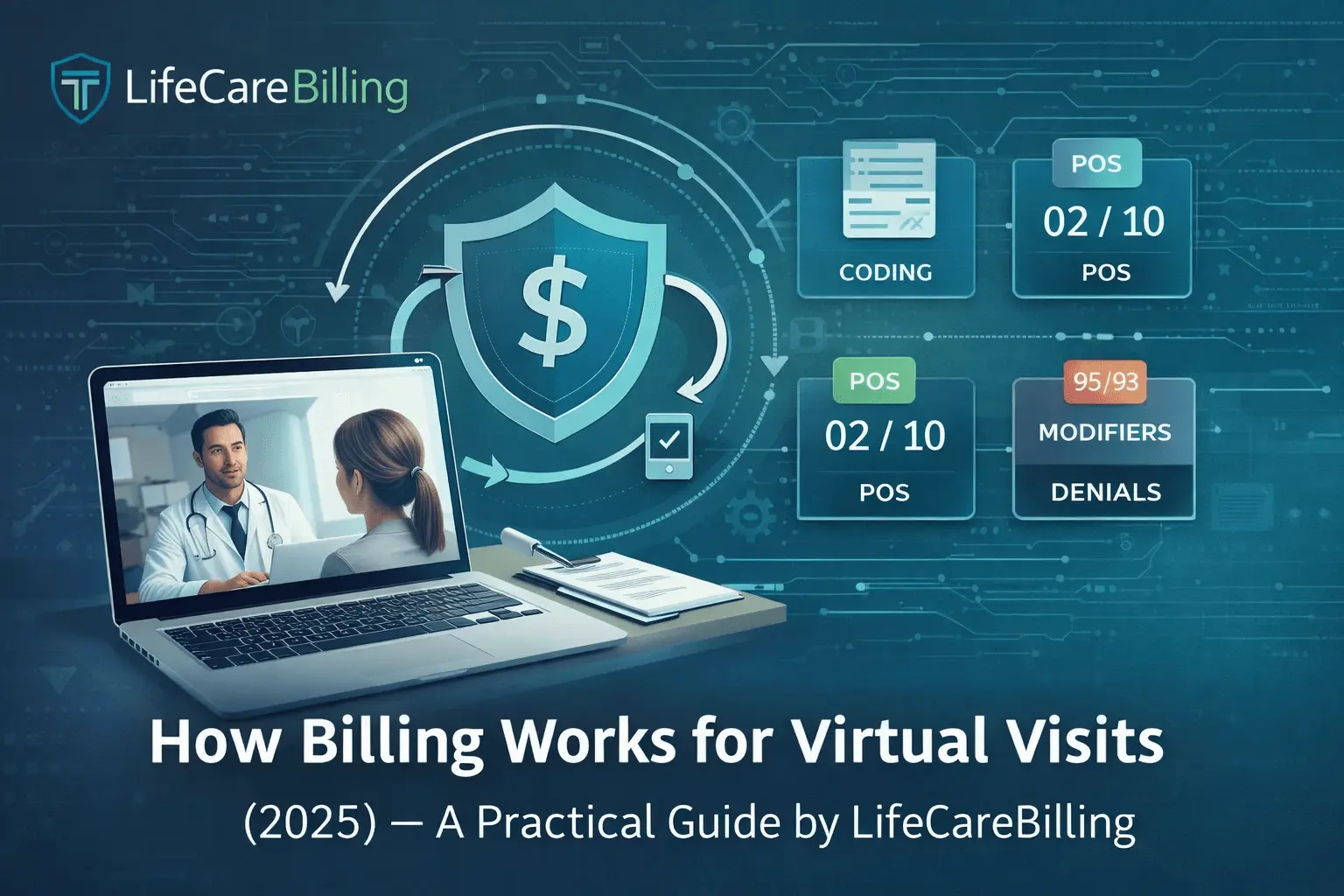
How Billing Works for Virtual Visits (2026) — A Practical Guide by LifeCareBilling
A virtual visit feels simple to patients. They click a link, meet their provider, and get care from home.
But behind the scenes, virtual visit billing is not “automatic.” It’s a workflow—one that can either pay smoothly, or quietly create denials, delays, and A/R stress.
If you’re here because you’re asking how billing works for virtual visits, you’re already thinking like an operator. And that’s smart, because most billing problems don’t happen because a provider did anything wrong clinically. They happen because the visit wasn’t set up correctly in the system, the payer rules weren’t followed, the place-of-service didn’t match the patient’s location, or the claim went out missing the right modifier.
At LifeCareBilling, we help practices and telehealth teams turn billing for virtual visits into a repeatable revenue engine—so you can scale without growing chaos. We support providers in New York (including Long Island) and nationwide with workflow-focused RCM, documentation alignment, denial prevention, and clean claim submission—so payments become predictable instead of stressful.
Why virtual visits get “seen” but don’t always get paid
Here’s the reality: your schedule can be full and your cash flow can still feel unstable.
That happens when telehealth visit billing is treated like an afterthought. Many teams assume, “If the visit happened, insurance will pay.” But payers don’t pay for “visits.” They pay for correctly billed services that match their rules.
The most common causes of payment delays are simple:
- Eligibility wasn’t checked correctly for telehealth benefits.
- The provider’s enrollment isn’t linked properly to the payer for telehealth.
- Documentation doesn’t clearly support the level of service.
- The claim used the wrong place of service—especially POS 02 vs POS 10. (telehealth.hhs.gov)
- The claim needed modifier 95 telehealth or modifier 93 audio-only (or payer-specific requirements) and didn’t include it. (Centers for Medicare & Medicaid Services)
LifeCareBilling exists to prevent these issues before they become A/R problems.
What counts as a “virtual visit” for billing purposes?
A virtual visit usually falls into one of these buckets:
- Live audio-video telehealth (the most common “telemedicine-style” visit)
- Audio-only visits (allowed in some scenarios, but heavily payer-dependent)
- Asynchronous or messaging-based services (varies widely by payer and service type)
Most practices are dealing with audio-video and sometimes audio-only. That’s why understanding telemedicine billing rules, payer requirements, and documentation expectations matters so much.
And yes—rules vary across Medicare, commercial plans, and state programs. That’s why we treat virtual care billing like a system, not a guessing game.
The step-by-step flow: how billing works for virtual visits
If you want how billing works for virtual visits explained simply, here’s the real-world sequence that keeps claims clean:
Step 1: Before the visit — confirm coverage and set the claim up correctly
This step is where most payment issues are born.
Before the provider ever sees the patient, your team should know:
- Is the patient eligible today?
- Does the plan cover telehealth for this service?
- Is prior authorization required?
- Is the provider properly enrolled and linked with the payer?
When this step is skipped, you can deliver perfect care and still get denied.
How LifeCareBilling helps here:We build eligibility + benefits routines and payer-specific checks into your operational workflow, so staff doesn’t “wing it.” We also support enrollment/credentialing coordination so claims don’t bounce for preventable administrative reasons.
If you want to see where your current process is leaking revenue, LifeCareBilling can run a Free Billing Analysis and show you what’s breaking and why.
Step 2: During the visit — document what payers expect (without slowing care)
Most providers don’t need “more documentation.” They need documentation that clearly supports billing.
For telehealth, the note should make these things easy to confirm:
- The service provided and why it was medically necessary
- Modality (audio-video vs audio-only)
- Patient location (especially home vs not-home)
- Time (if billing is time-based) or clear MDM support (if billing by MDM)
- Any consent language if required by payer or policy
That “patient location” detail is not a small thing. It directly affects telehealth coding choices like POS 02 vs POS 10 for many payers, and it can affect reimbursement. (telehealth.hhs.gov)
How LifeCareBilling helps here:We help practices align documentation habits with payer expectations so billing doesn’t require rework later. Clean documentation reduces denials, reduces downcoding, and speeds payment.
Step 3: After the visit — code it correctly and apply the right POS/modifiers
This is the part people usually think of when they think of telehealth reimbursement—the “claim submission” moment.
But a clean claim depends on three things working together:
- Correct service code selection (E/M or other applicable codes)
- Correct place of service logic (POS 02 vs POS 10) (telehealth.hhs.gov)
- Correct modifier logic (often modifier 95 telehealth or modifier 93 audio-only, depending on payer and service) (Centers for Medicare & Medicaid Services)
Now let’s break the two biggest confusion points in plain language.
POS 02 vs POS 10 (why this matters more than most teams realize)
If your team is doing virtual visit billing, POS is one of the most important accuracy points.
HHS telehealth guidance explains it clearly for Medicare Fee-for-Service billing:
- POS 02 = telehealth provided other than in the patient’s home
- POS 10 = telehealth provided in the patient’s home (telehealth.hhs.gov)
CMS also publishes the official place of service code set definitions and notes you should check payer reimbursement policies for POS usage. (Centers for Medicare & Medicaid Services)
Why does this matter financially? Because for Medicare, payment can differ depending on POS. A common pattern discussed in payer guidance is facility vs non-facility pricing (POS 02 often aligns with facility-rate pricing while POS 10 aligns with non-facility-rate pricing). (telehealth.hhs.gov)
How LifeCareBilling helps:We build a simple operational rule into your workflow: patient location drives POS selection. That prevents staff guessing, prevents inconsistent claims, and reduces payment surprises.
Modifier 95 vs Modifier 93 (telehealth vs audio-only)
Modifiers are payer signals. They tell the payer “what kind of telehealth this was.”
modifier 95 telehealth
CMS telehealth guidance (MLN) includes references to using modifier 95 for certain telehealth services in specific contexts. (Centers for Medicare & Medicaid Services)At the same time, some commercial payers may accept modifiers as informational or may not require them for some services—so you must follow the payer’s policy, not assumptions. (UHC Provider)
modifier 93 audio-only
The AMA explains that CPT Appendix T lists codes that may be used for reporting audio-only services when appended with modifier 93 audio-only. (American Medical Association)
How LifeCareBilling helps:We don’t treat modifiers like “best guesses.” We build payer-specific modifier rules into your billing process, then quality-check claims before submission. That’s how you reduce denials without slowing volume.
What happens after the claim is submitted
After the claim is sent, one of three things happens:
- It pays cleanly and closes quickly
- It’s delayed and needs payer follow-up
- It denies and requires correction/appeal
The difference between a stable telehealth operation and a stressful one is not whether denials happen—denials happen everywhere. The difference is whether denials are tracked, categorized, fixed at the root cause, and prevented from repeating.
This is where telehealth billing services truly matter—because telehealth volume grows fast, and if you don’t have a denial engine, A/R grows even faster.
How LifeCareBilling helps:We treat denials like signals. We track patterns, identify what’s causing repeated telehealth denials (POS mismatch, missing documentation elements, eligibility failures, enrollment/linking issues, modifier mistakes), then fix the workflow—not just the single claim.
That’s how you protect telehealth reimbursement long-term.
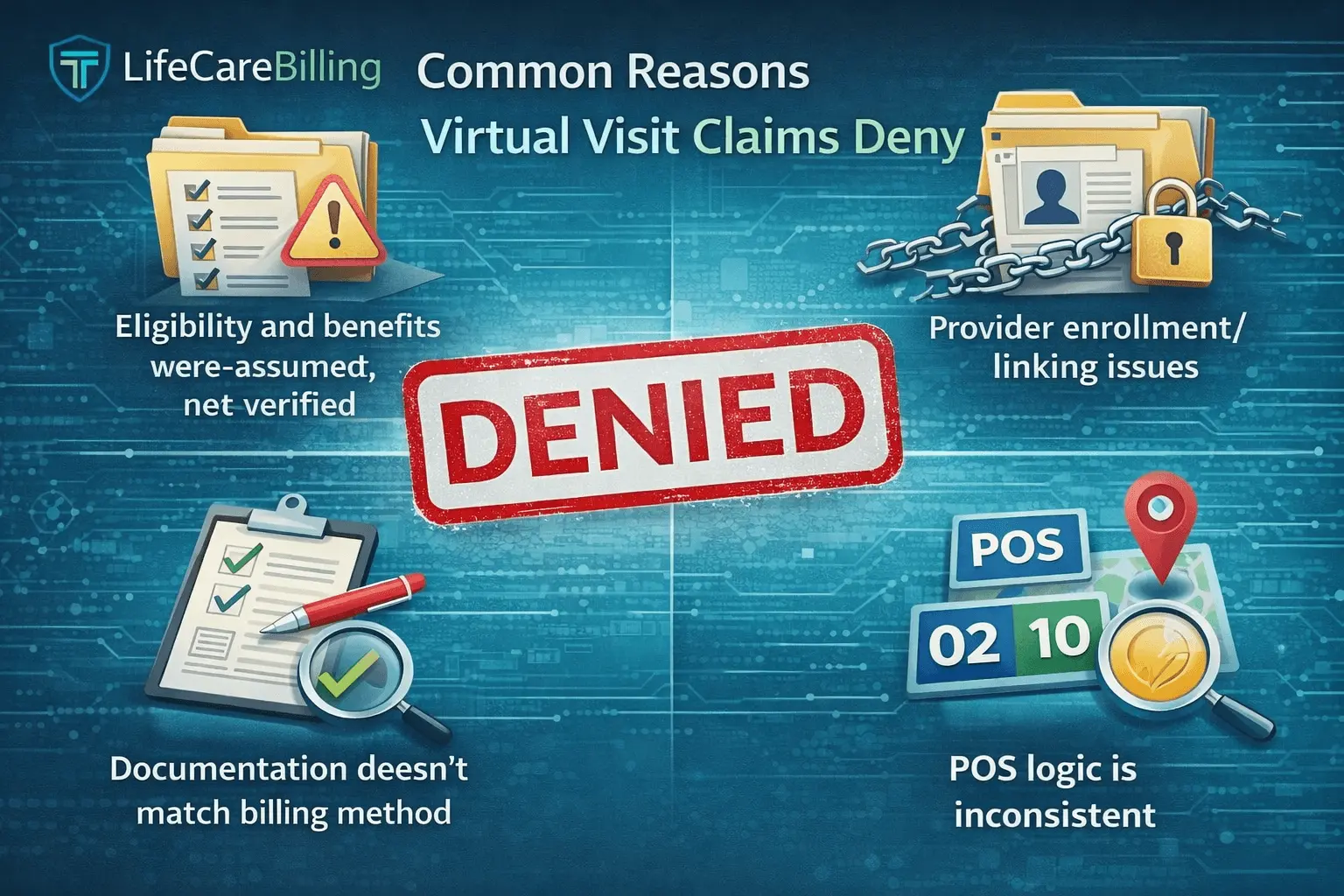
The most common reasons virtual visit claims deny (and the real fixes)
When practices ask us why billing for virtual visits is “so inconsistent,” these are the patterns we usually find:
1) Eligibility and benefits were assumed, not verifiedTelehealth coverage varies. Some plans require specific conditions. Some require prior authorization. Some are strict about modality.
2) Provider enrollment/linking issuesA provider may be credentialed, but not properly linked to the payer/group setup for telehealth claims—causing rejections that feel “random.”
3) Documentation doesn’t match billing methodThe care may be excellent, but the note doesn’t clearly support the billed level of service.
4) POS logic is inconsistentPOS 02 vs POS 10 gets confused when teams don’t capture patient location consistently. (telehealth.hhs.gov)
5) Modifier logic isn’t payer-specificmodifier 95 telehealth and modifier 93 audio-only are not “one-size-fits-all.” The rule is: follow the payer policy. (Centers for Medicare & Medicaid Services)
LifeCareBilling’s approach: we build the rules into the workflow so staff doesn’t have to memorize them. That’s how you scale safely.
The LifeCareBilling difference: we make virtual visit billing predictable
A lot of companies can submit claims.
LifeCareBilling is built to make your telehealth operation run like a system—so you don’t feel like you’re constantly reacting.
We support your telehealth growth with:
- Clean intake + verification workflows (so you stop starting visits with billing uncertainty)
- Documentation alignment (so your notes support billing without creating after-visit rewriting)
- Payer-aware POS + modifier logic (so POS 02 vs POS 10 and modifier 95 telehealth / modifier 93 audio-only stop causing rework)
- Denial prevention and fast follow-up (so problems don’t sit in A/R for months)
- Reporting visibility (so you can see what’s paid, what’s pending, what’s denying, and why)
If you’re searching for virtual visit billing services, telehealth billing services, telemedicine billing company, or telehealth billing company near me, LifeCareBilling is designed for this exact operational need—especially for New York providers (Long Island/NYC area) and for multi-state telehealth teams.
Mid-blog CTA (for conversions):If your telehealth volume is growing and your payments aren’t keeping up, click Get Free Billing Analysis or call (631) 966-1755. We’ll identify what’s slowing your payments and show you how to stabilize your telehealth revenue.
Local coverage + nationwide support
LifeCareBilling supports providers in:
- Commack / Long Island / Suffolk County / Nassau County
- New York City (Queens, Brooklyn, Manhattan, Bronx, Staten Island)
- and telehealth teams serving patients across the U.S.
That’s why we naturally support searches like virtual visit billing near me and also “telehealth billing nationwide”—because telehealth doesn’t stay inside one zip code.
Final takeaway: virtual visits are easy — billing for them must be engineered
If there’s one message to remember, it’s this:
Virtual care scales quickly. But virtual care billing only scales when your workflow is structured.
When you treat telehealth as a system—eligibility, documentation, POS logic, modifier logic, claim quality checks, denial tracking, and consistent A/R follow-up—telehealth becomes predictable. It stops feeling like “we hope it pays.”
That’s what LifeCareBilling builds.
Final CTA:Want to know exactly what’s working, what’s risky, and what’s leaking revenue in your current telehealth workflow? Call (631) 966-1755 or click Get Free Billing Analysis. LifeCareBilling will help you stabilize virtual visit billing and keep telehealth growth profitable.
Frequently Asked Questions
How billing works for virtual visits with insurance?▼
How billing works for virtual visits depends on eligibility, payer telehealth coverage, correct coding, correct POS selection, correct modifier use when required, and documentation that supports the billed service.
What is the difference between POS 02 vs POS 10?▼
POS 02 vs POS 10 generally separates telehealth provided other than in the patient’s home versus telehealth provided in the patient’s home (Medicare definitions).
Do I always need modifier 95 telehealth?▼
Not always. Some payers require modifier 95 telehealth for certain services, while others may accept it as informational or may not require it for some telehealth-coded services—always follow payer policy.
What is modifier 93 audio-only used for?▼
Modifier 93 audio-only is used for certain audio-only services when applicable (and for codes listed in CPT Appendix T), depending on payer rules.
How can LifeCareBilling help telehealth providers?▼
LifeCareBilling helps by building a structured telehealth billing system—eligibility routines, documentation alignment, payer-aware POS/modifier logic, denial prevention, A/R follow-up, and reporting—so telehealth payments become predictable as volume grows.